


HACCP plans that protect people, not paperwork.
Most HACCP plans are written once and quietly fall behind the process they are meant to control. Our consultants build a plan around your actual products, hazards, and process flow, then put it inside software that keeps it current as the operation changes. Already have a plan? We will tell you honestly where it has drifted. Led by a PCQI Lead Instructor.
A HACCP plan that does its job between audits.
The plan is only worth what it does on an ordinary Tuesday. Beacon keeps yours working between audits, not just filed for one.
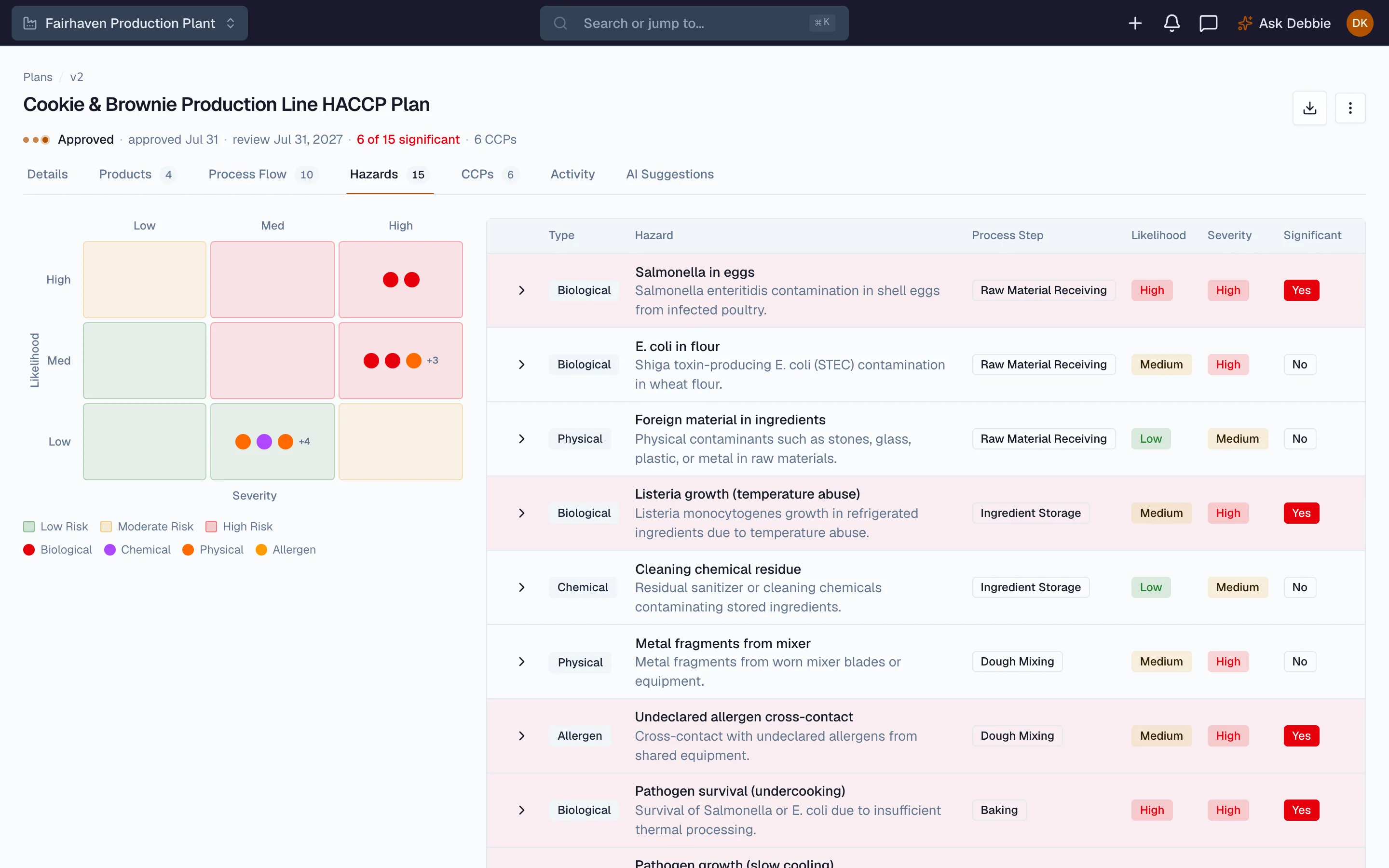
Beacon drafts the hazard analysis from your product, ingredients, and process flow, then your consultant verifies every line. You start from a structured draft instead of a blank page, and the science still gets a human check before anything is final.
Explore Hazard analysis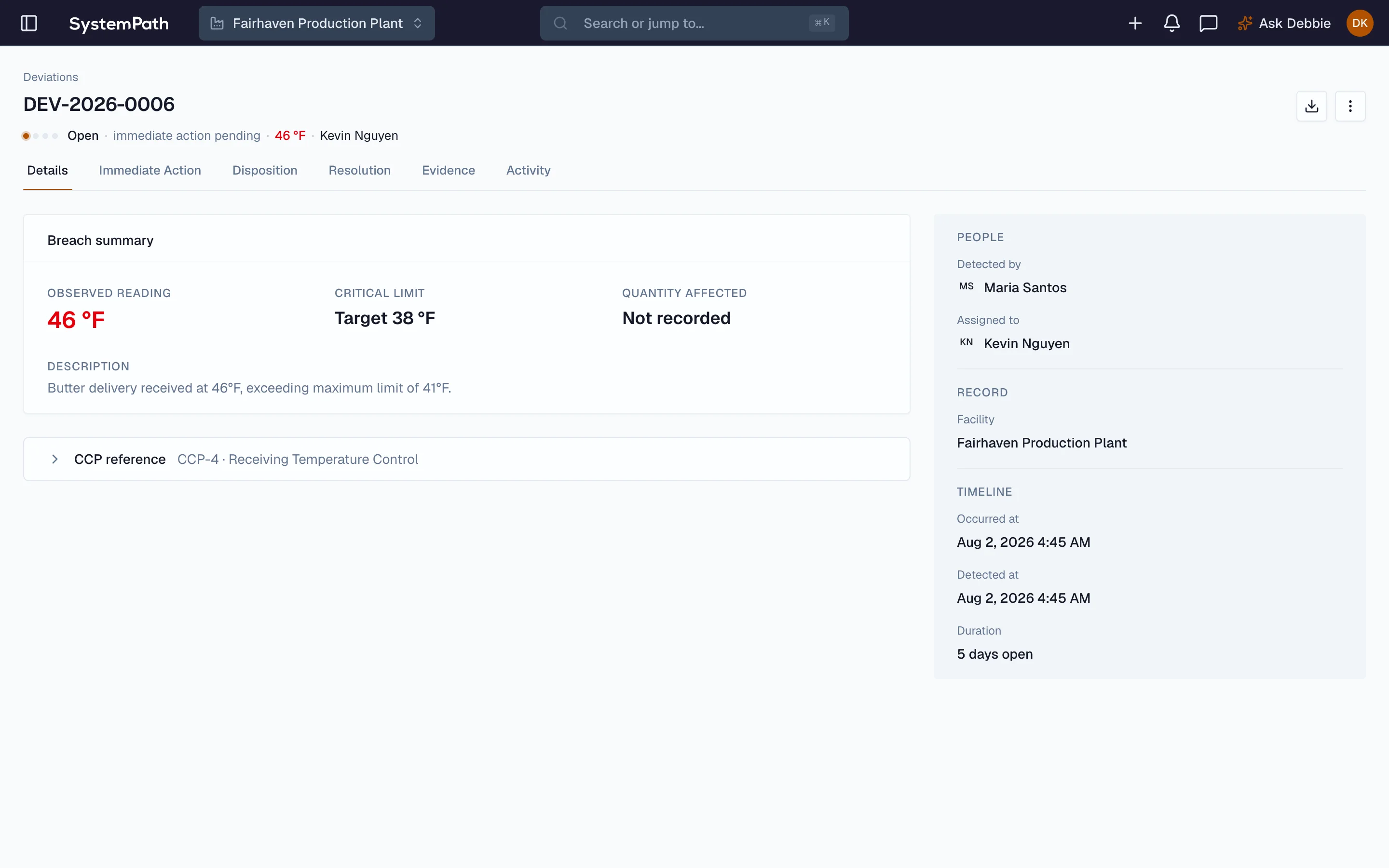
Limits live on the digital forms your team fills out at the line. A reading outside the limit is caught in the moment, not at the end of the shift, and it opens a deviation your team routes to a corrective action.
Explore CCP monitoring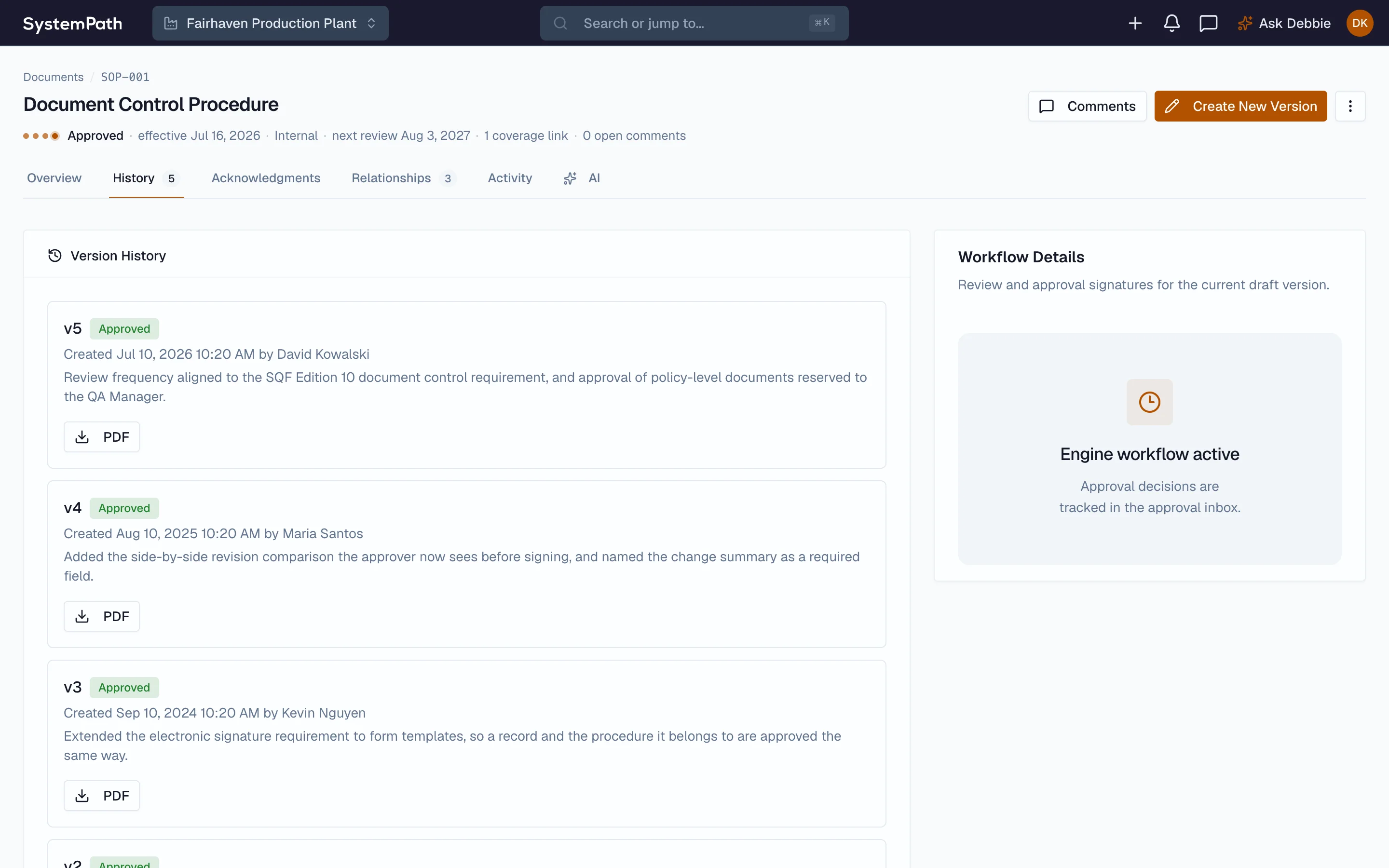
Process flows link to CCPs, CCPs link to monitoring, and every edit is version-controlled with an e-signature and a full change history, instead of being reconstructed from paper.
Explore Living documentation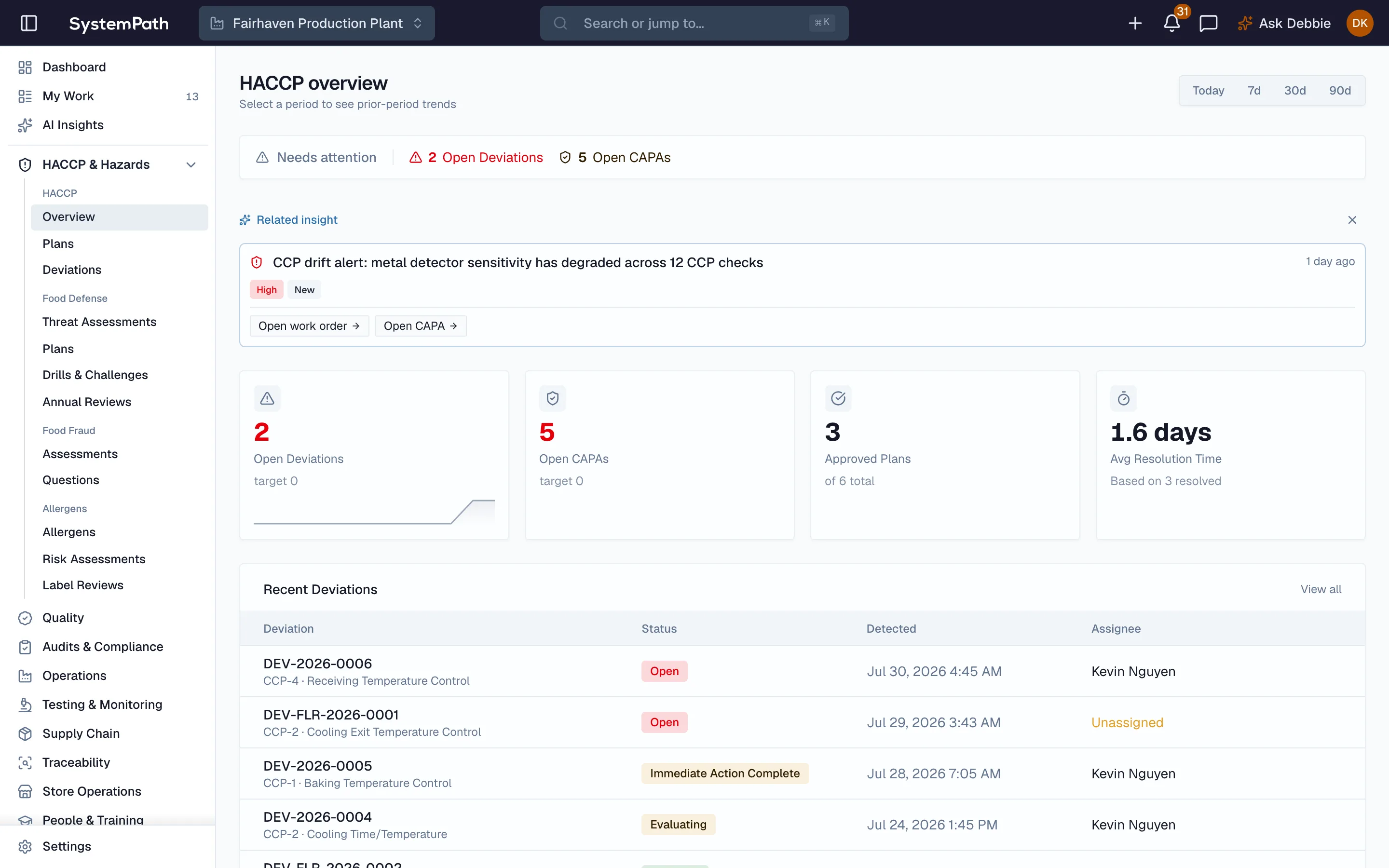
Change a process or add a product and Beacon flags the affected CCPs for review and prompts a hazard analysis. Annual reassessment reminders fire on their own, so the plan stays the most current document in your facility.
Explore ReassessmentThe 7 principles of HACCP, done right
HACCP is a systematic approach to food safety built on seven principles from Codex Alimentarius. Each one means something specific in practice, and each is a place plans fall short.
Have us review your planConduct a hazard analysis
Identify every biological, chemical, and physical hazard for your products. A facility-specific analysis of your ingredients, process, and environment, not a template copy. This is where most plans fall short.
Determine critical control points
Find the process points where control is essential to prevent or reduce a hazard. Not every step is a CCP. Misjudging them means wasted monitoring or real risk.
Establish critical limits
Set the measurable boundary for each CCP: temperature, time, pH, water activity. Limits must rest on scientific evidence or regulation, never guesswork.
Establish monitoring procedures
Define how, when, and by whom each CCP is checked, often enough to catch a deviation before affected product leaves your control.
Establish corrective actions
Pre-plan what happens when a limit is exceeded: who is notified, what happens to the product, how the process is brought back in control.
Establish verification procedures
Confirm the plan actually works through calibration checks, record reviews, testing, and periodic reassessment.
Establish record-keeping
Document monitoring, corrective actions, verification, and the plan itself, retained per regulation. Beacon handles this as a byproduct of the work.
Led by an instructor who has taught HACCP since 1987.
Our HACCP work is led by Jeffrey Strout, SystemPath's Food Safety Director, and the practitioners on our bench. A PCQI Lead Instructor who has taught HACCP since 1987, and a former SQF Lead Auditor with 7,500+ audits, he has built and reviewed hazard analyses from bakery lines to cook-chill operations.
He knows where a plan's science tends to break, because he was the auditor who found it.
Who you're working with
Both sides of the table
Years of audit-side experience
A former SQF Lead Auditor and HACCP Alliance Instructor leading every engagement.
Audits conducted
On the side of the table that asks the questions.
Working SQF-certified plant
PCQI-certified, FSPCA-trained practitioners running preventive controls on Beacon every day.
Every element of your HACCP plan, built in Beacon
A complete plan, not a template. Each element is facility-specific and connected to the operations it governs.
Product description and intended use
Specifications, intended consumers, allergens, shelf life, storage, and distribution.
Process flow diagrams
Every step from receiving to shipping, verified on the production floor.
Hazard analysis
Biological, chemical, and physical hazards per step, with likelihood, severity, and control measures.
CCP determination
Critical control points identified with the Codex decision tree, and clear justification for each.
Critical limits and justification
Measurable limits grounded in regulation or validated studies, never arbitrary numbers.
Monitoring procedures
What, how, when, and who, wired to digital forms for real-time validation.
Corrective action procedures
Pre-planned responses for every deviation: product disposition, correction, and root cause.
Verification and validation
Scheduled record review, calibration, testing, and annual plan reassessment.
Get a HACCP plan built on the science, not a template
A 20-minute call with a consultant who can tell you in plain terms where your hazard analysis is solid and where it is exposed.
Prefer the phone? (313) 484-4887
What happens next
Discovery call
About your facility and goals. Not a sales pitch.
See it in action
A live walkthrough of Beacon scoped to your operation.
Custom proposal
Software, consulting, and training sized to your facility.
You'll talk with a food safety expert, not a sales rep.
20 minutes · No commitment · No pressure
Tell us about your process
Send the basics and we come to the call already knowing your products, your process, and where your current plan might be exposed.
HACCP consulting questions, answered
Common questions about plan development, the 7 principles, and working with our team.