


Every batch on the record.
Electronic batch records executed against a master, Part 11-ready signatures on the work, an append-only inventory ledger with full lot genealogy, and the FSMA 204 transformation event emitted when the run completes.
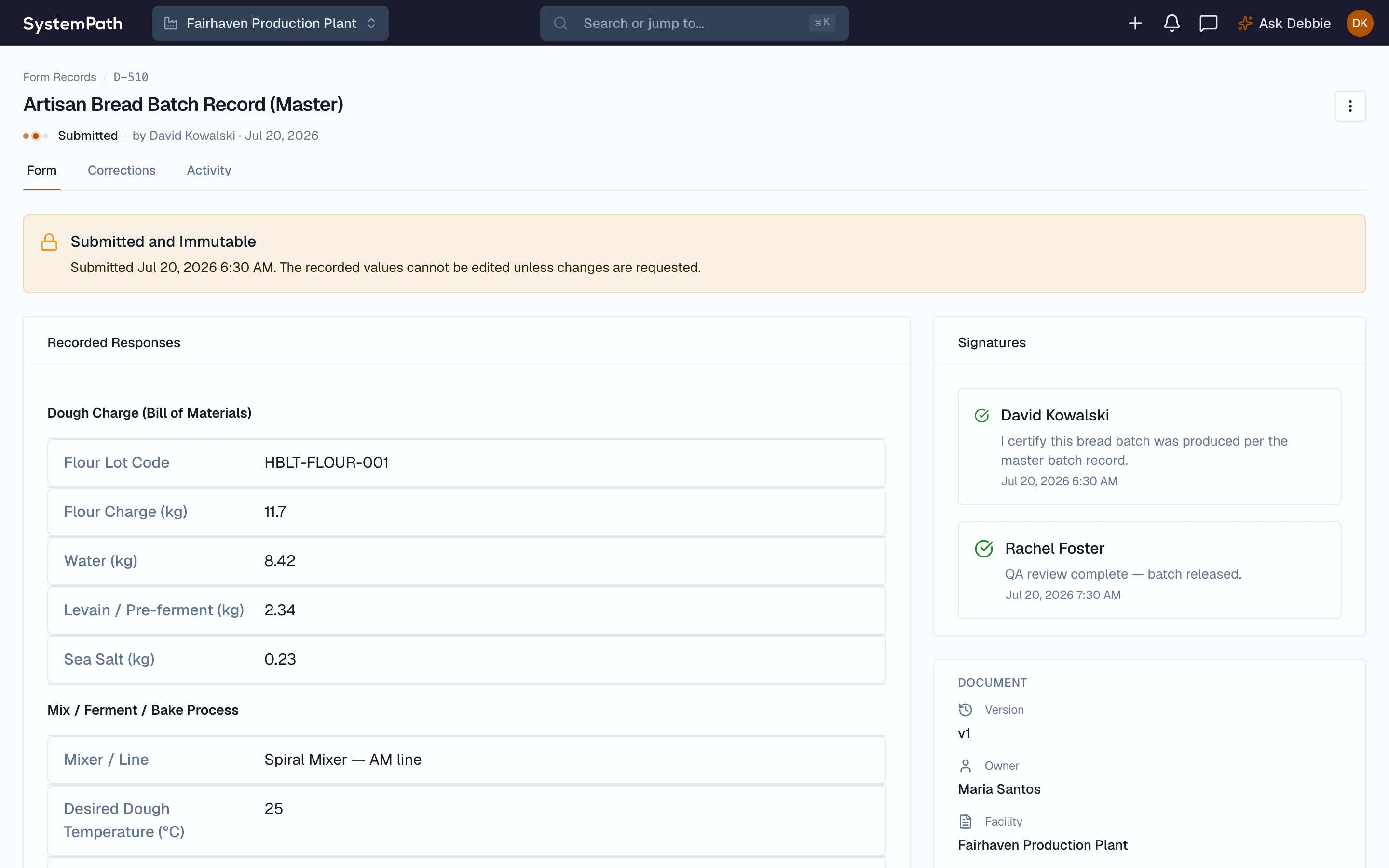
The run is finished when the record is, not the next morning.
You build a master batch record once, with its sections, in-process checks, and signature gates, and each run executes against it. The run carries its planned and actual quantity, its output lot, its recipe version, and its shift, and it moves through schedule, execution, completion, and QA release with each step attributed. Release is held for a separate approver, so the person who ran the batch is not the person who releases it.
- A master batch record built once, executed per run
- Start and complete signed with Part 11-ready electronic signatures
- Planned against actual quantity, with the output lot on the record
- Release held for a separate approver
- The finished record complete and searchable the moment the run ends
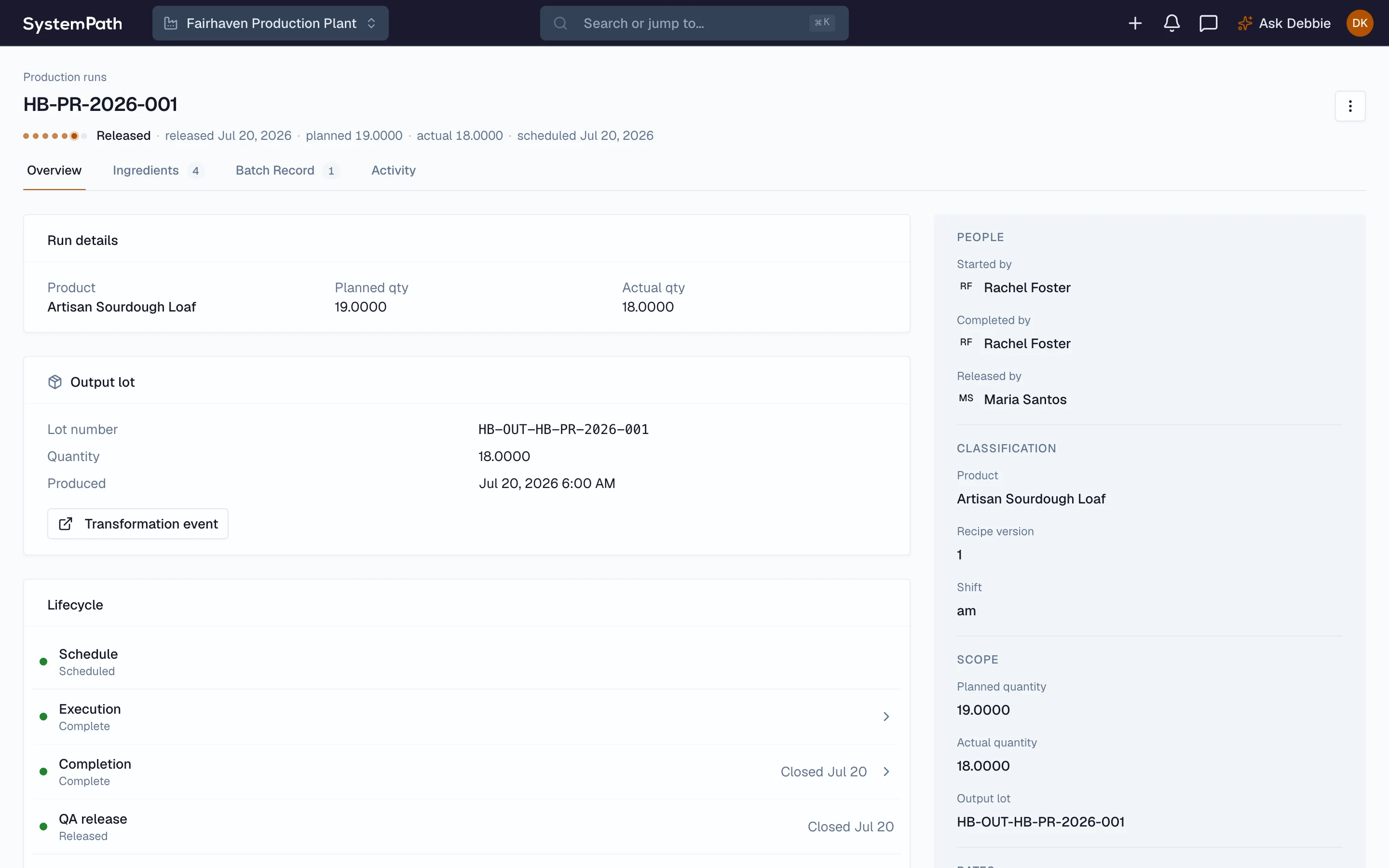
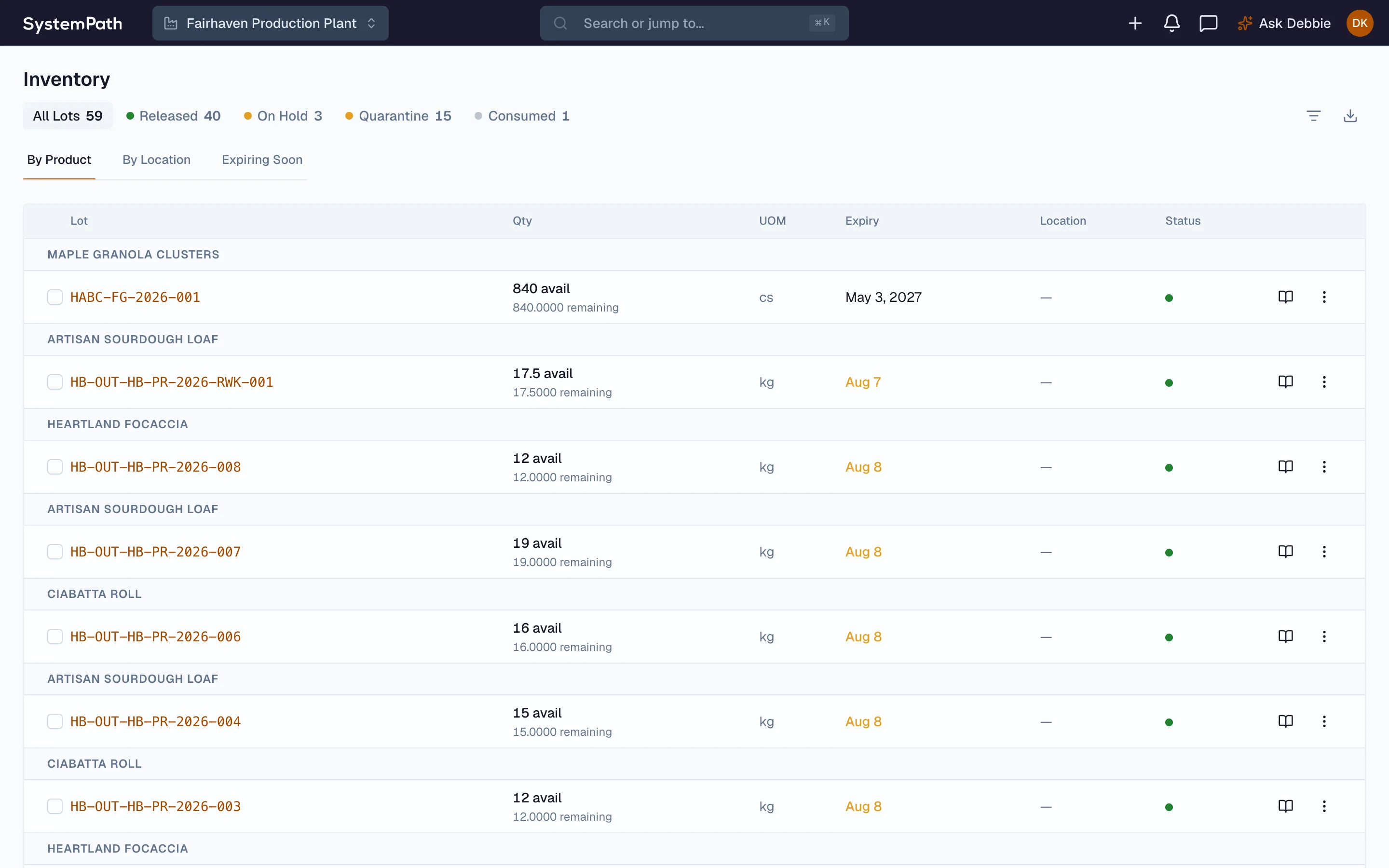
Stock you can act on, because it knows its own status.
Inventory is an append-only ledger rather than a running total someone edits. Every lot carries its quantity, its expiry, and its release status, so quarantined and held material is visibly not available rather than quietly counted. Allocation picks first-expired-first-out with lot identity preserved, and the same ledger is what the genealogy and the recall trace read from.
- Append-only: every movement posts, nothing is overwritten
- Released, on hold, quarantined, and consumed as distinct states
- FEFO and FIFO allocation with lot identity preserved
- By product, by location, and expiring soon as live views
- The same ledger the genealogy and the recall trace read
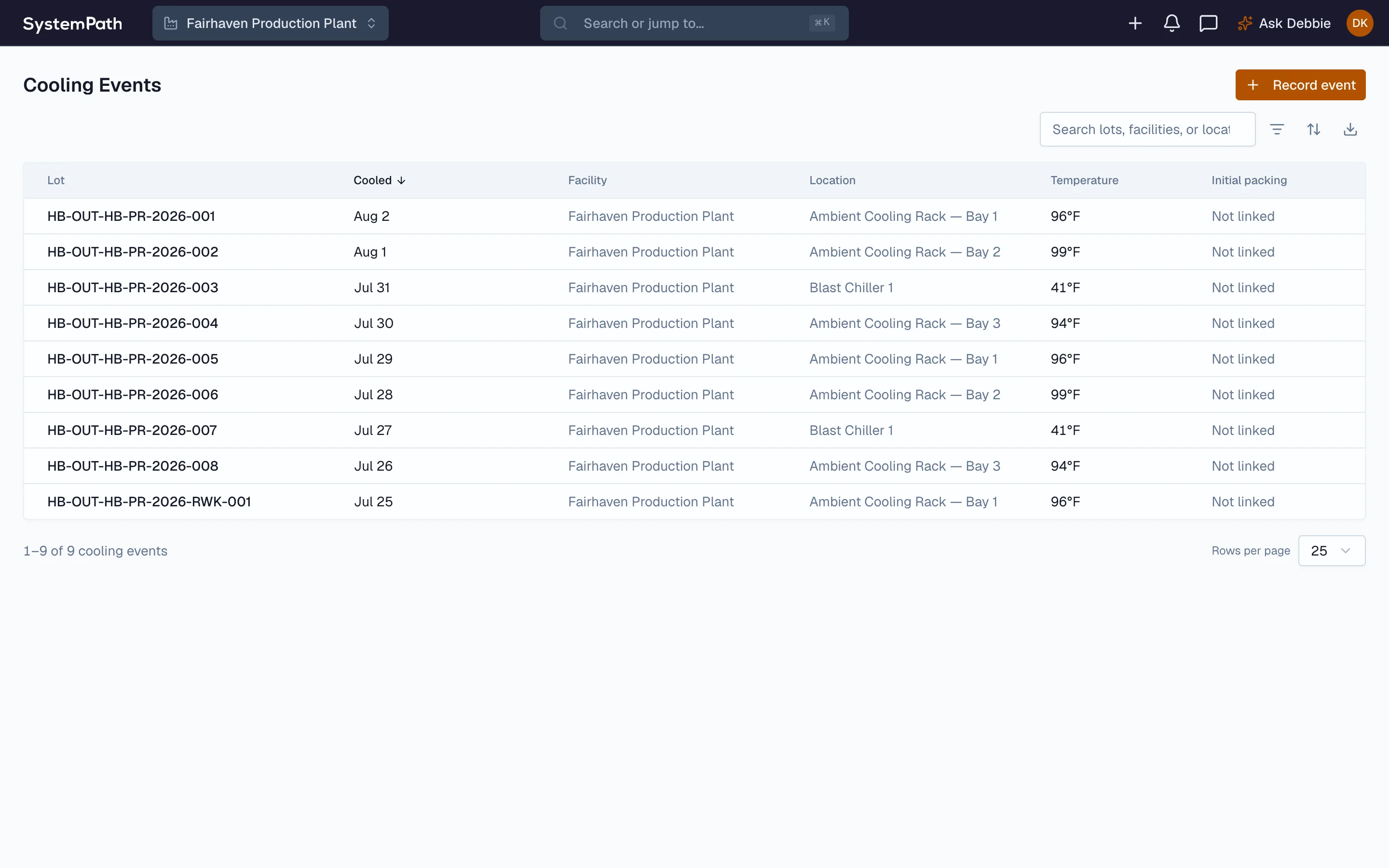
The traceability event is a byproduct of finishing the run.
Completing a production run emits the transformation Critical Tracking Event with the Key Data Elements 1.1350 requires, and queues an EPCIS 2.0 export. Cooling events are recorded against the lot with the location and the temperature, so the event log is built from the work rather than reconstructed from it. Enforcement is set for July 20, 2028; a plant that records events as it produces has nothing to reconstruct.
- The transformation event emitted when a run completes
- Cooling events recorded against the lot with location and temperature
- Key Data Elements captured per event type
- EPCIS 2.0 JSON-LD and the FDA sortable spreadsheet
Every production question an auditor asks, answered before they walk in.
Production is audited by picking a batch and asking what happened. The record either exists as the batch was made, or it gets written afterwards from memory, and an auditor can tell the difference.
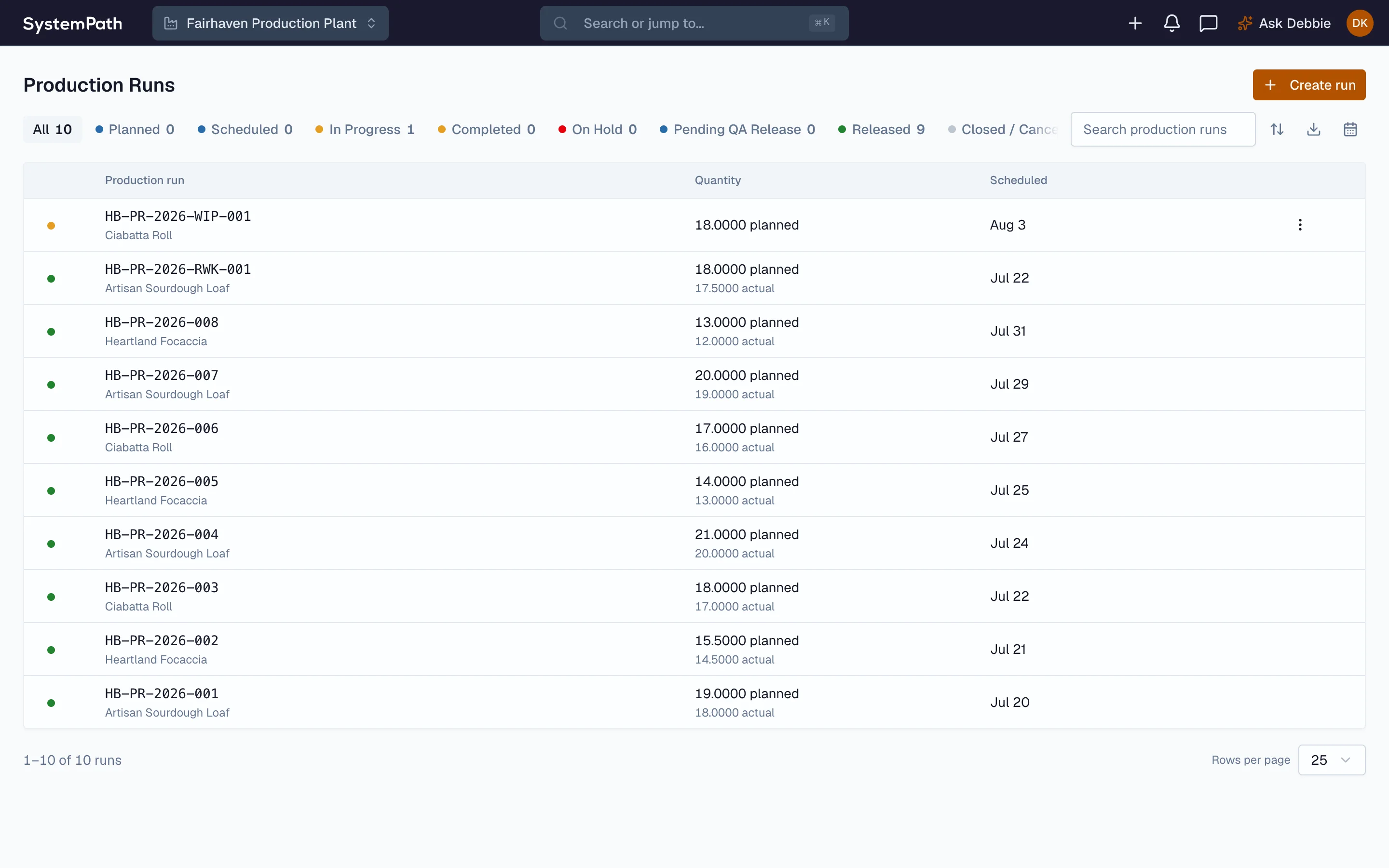
The run register carries every batch with its product, its status, its planned and actual quantity, and its output lot. The answer to "show me last Tuesday" is a filter rather than a folder.
Explore Run history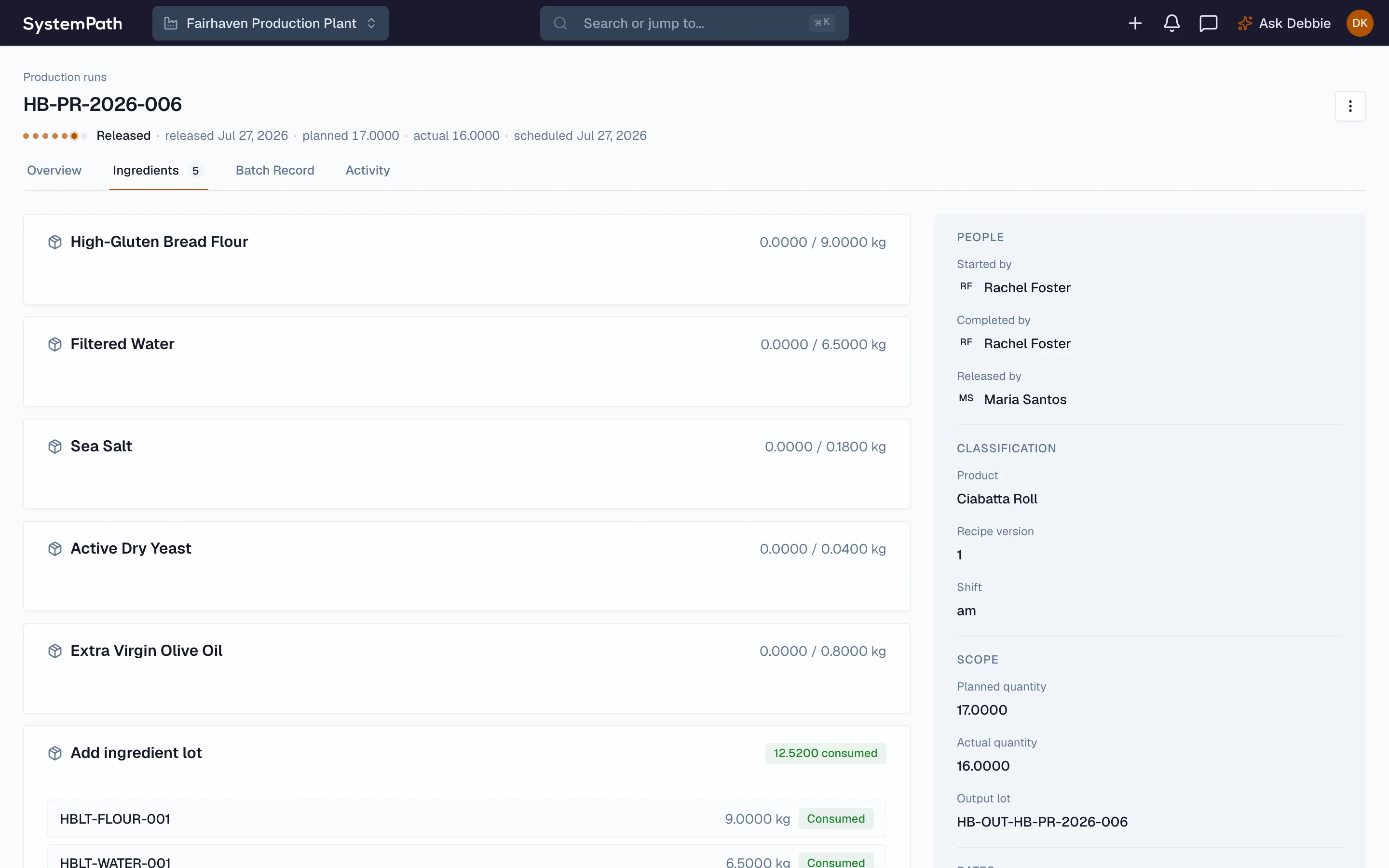
Each ingredient on the run shows what the recipe called for and the actual lots consumed against it. That is the record a trace walks backward through, and it is captured while the batch is being made.
Explore Bill of materialsSee a batch record signed and released.
A 20-minute walkthrough of a run executed against its master record, the ledger it moves, and the traceability event it emits. Bring your batch sheet.
Prefer the phone? (313) 484-4887
What happens next
Discovery call
About your lines, your batch sheets, and who signs what today.
Live walkthrough
A run executed against a master record and released by a second person.
Custom proposal
Software, consulting, and training sized to your operation.
You'll talk with a food safety expert, not a sales rep.
20 minutes · No commitment · No pressure
Questions production teams ask.
Answers from the team that runs Beacon inside a working SQF-certified plant.
An electronic batch record (EBR) is the executed record of a production run. You build a master batch record once, with the required sections, in-process checks, and signature gates, then each run executes against it. The run is started and completed with Part 11-ready electronic signatures, ingredients are allocated by FEFO from the inventory ledger, and the finished record is complete and searchable the moment the run ends. No transcribing a paper batch sheet the next morning.
Each act that needs a signature, starting a run, completing it, takes a PIN-verified electronic signature tied to the user and the moment. QA release is gated by a separate approval, so the person who runs the batch is never the person who releases the finished lot, and release itself is gated on evidence: specifications, certificates, and checks must be green before the lot ships. Each signature is hash-chained to the one before it, so the signed history travels with the run and an edit after the fact breaks the chain. Worth knowing: most food records are not actually subject to Part 11 (the rule binds records like dietary supplements and OTC drugs). Beacon applies Part 11-grade signature controls to food records anyway, because that is the standard an auditor recognizes.
Inventory is an append-only ledger, not a balance you overwrite. Every receipt, allocation, consumption, hold, release, and adjustment is a posted entry, so the on-hand quantity is always the sum of its history. That is what makes lot genealogy reliable: every lot carries the full record of what went into it and where it went.
Yes. Completing a production run emits the FSMA 204 transformation Critical Tracking Event automatically, with the Key Data Elements §1.1350 requires, and queues an EPCIS 2.0 export. The traceability event is a byproduct of finishing the run, not a separate project you staff the quarter before the deadline.
Seconds, from your desk. Because every lot carries its genealogy on the append-only ledger, one view shows the forward and backward trace: which raw lots went into a finished lot, which finished lots came out, and where each one shipped. There is no spreadsheet to rebuild under pressure when a retailer or the FDA asks where a lot went.
Yes. You can place a lot on hold and release it through a controlled step, and a run can split, merge, or send quantity to rework with the genealogy preserved across every operation. Scrap and rework quantities are captured against the run, so yield variance reconciles instead of disappearing.