

Every AI action leaves a record.
Beacon's AI drafts CAPAs and SOPs, checks your documents against each other, reads COAs, and runs mock audits. Every action it takes writes an evidence record you can review, accept, or reject.
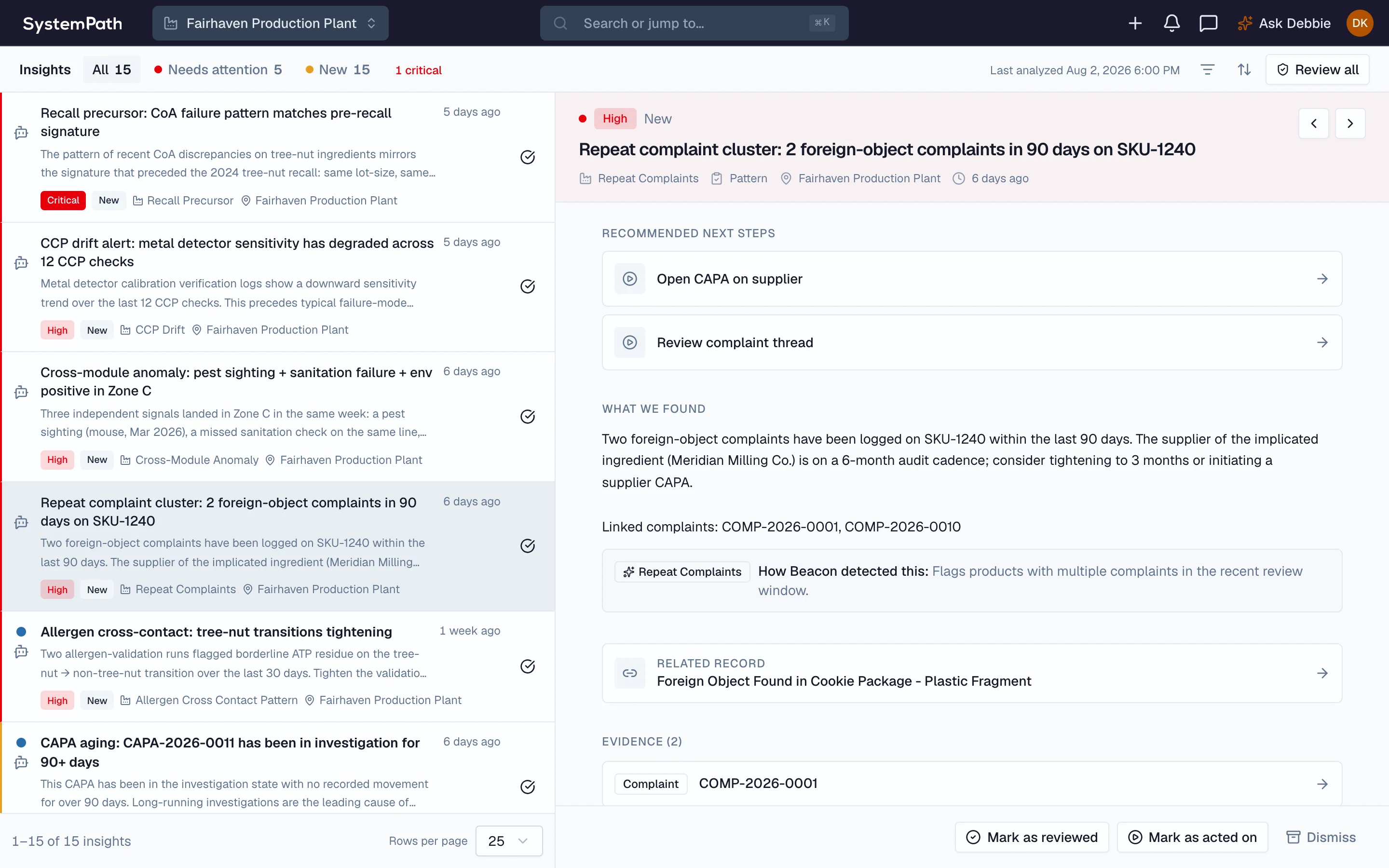
The AI drafts the work. The evidence makes it checkable.
Every AI write leaves an evidence item behind: what the model was given, which model answered, the sources it drew on, and the moment it happened. A draft arrives labelled as a draft, with the record it came from named on it, and a person disposes of it by accepting or dismissing. That call is recorded too. The same evidence panel renders on more than thirty surfaces in the app, so the trail is one click away wherever the AI did work.
- An append-only evidence item for every AI write
- Inputs, model, sources, and timestamp captured
- A draft is labelled a draft, with its source record named
- Accepted or dismissed by a qualified reviewer, and that is recorded
- One evidence panel, on more than thirty app surfaces
Watch Beacon AI work across the program.
The same intelligence runs everywhere your program does: catching deviations, opening corrective actions, reconciling supplier COAs, classifying findings, and matching new regulations to the SOPs they touch. Each action you see here left an evidence record behind it.
Human-in-the-loop
Nothing changes your program unattended.
Four languages
English, Spanish, French, and Arabic, right-to-left.
Never trains on your data
Your content is processed, not used to train models.
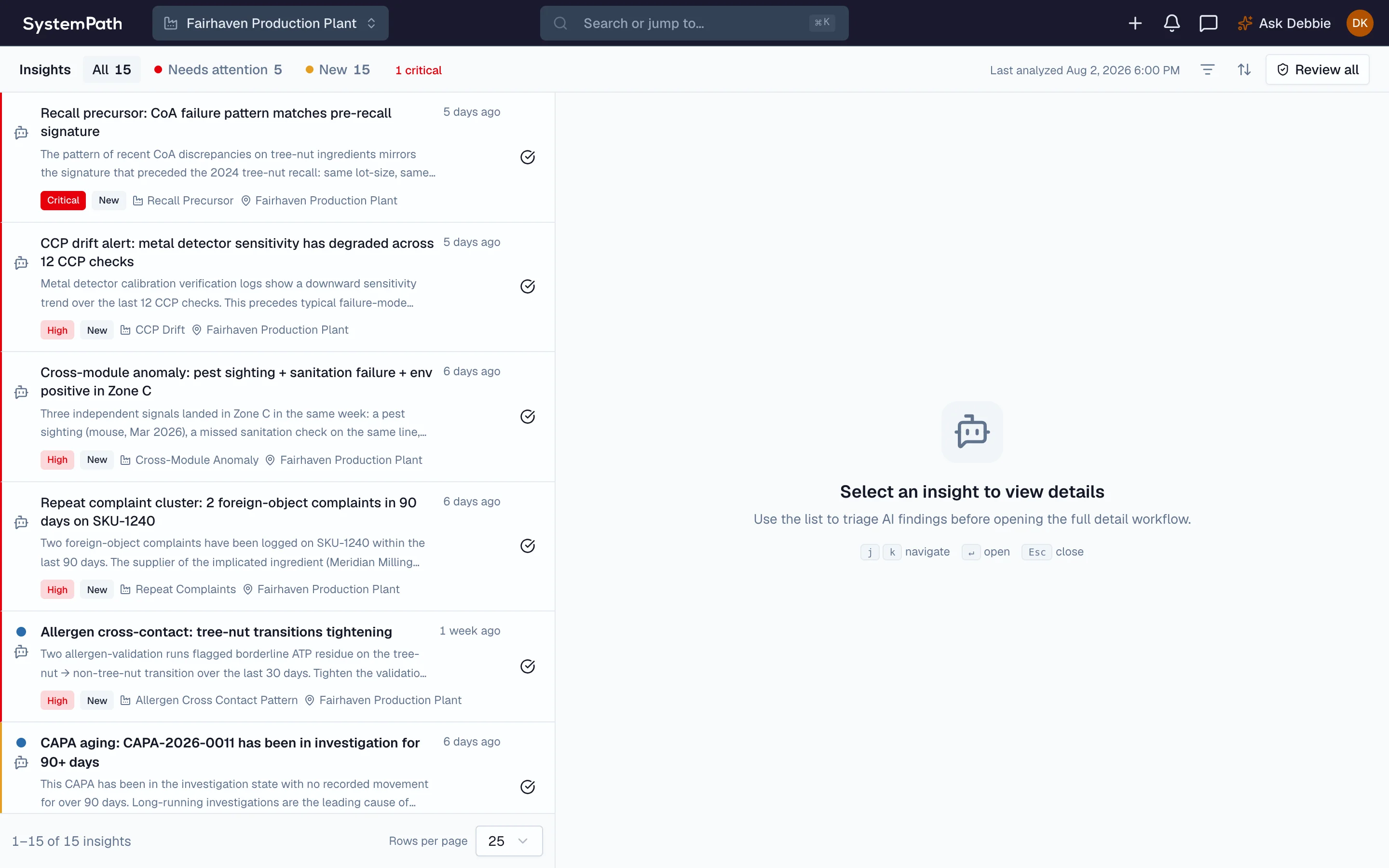
Named features, not a vague promise.
The insights queue is where most of it surfaces: repeat complaint clusters, CCP drift, cross-module anomalies where a pest sighting, a missed sanitation check and an environmental positive land in the same zone in the same week. Each carries the detector that found it, so a finding is attributable to a rule rather than to a black box.
- Ask Beacon: questions in plain language, every answer cited
- CAPA root-cause assistant, drafting from a finding or deviation
- SOP drafting, and consistency checks across existing SOPs
- Vision reading of COAs, labels, and equipment photos, pulled out for your review
- Mock-audit agent scoring readiness before the real thing
- Regulatory-change monitoring, in development
The two questions an auditor asks about AI.
Auditors do not object to software suggesting things. They object to a program that cannot say who decided. Both answers here are screens, not policy statements.
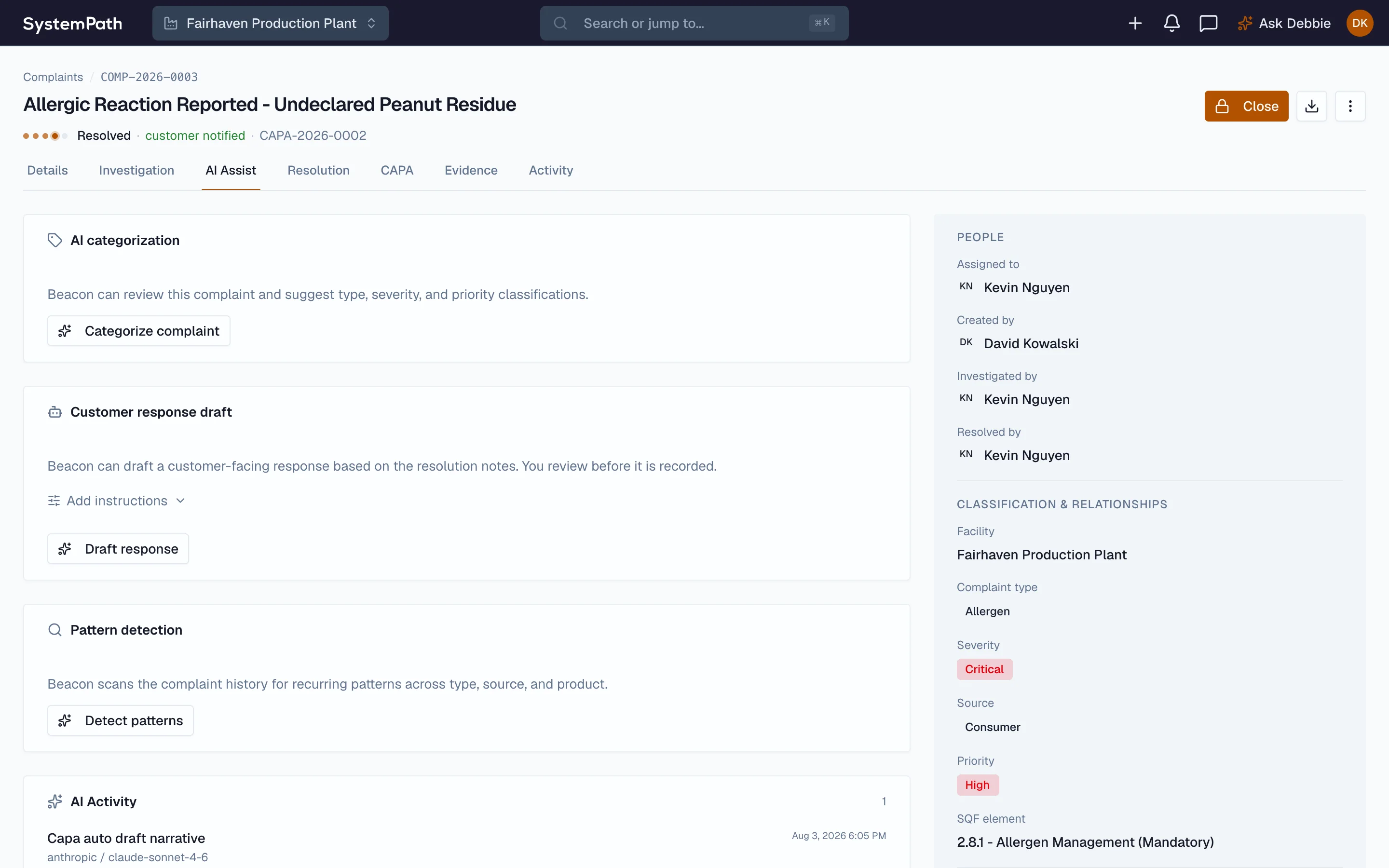
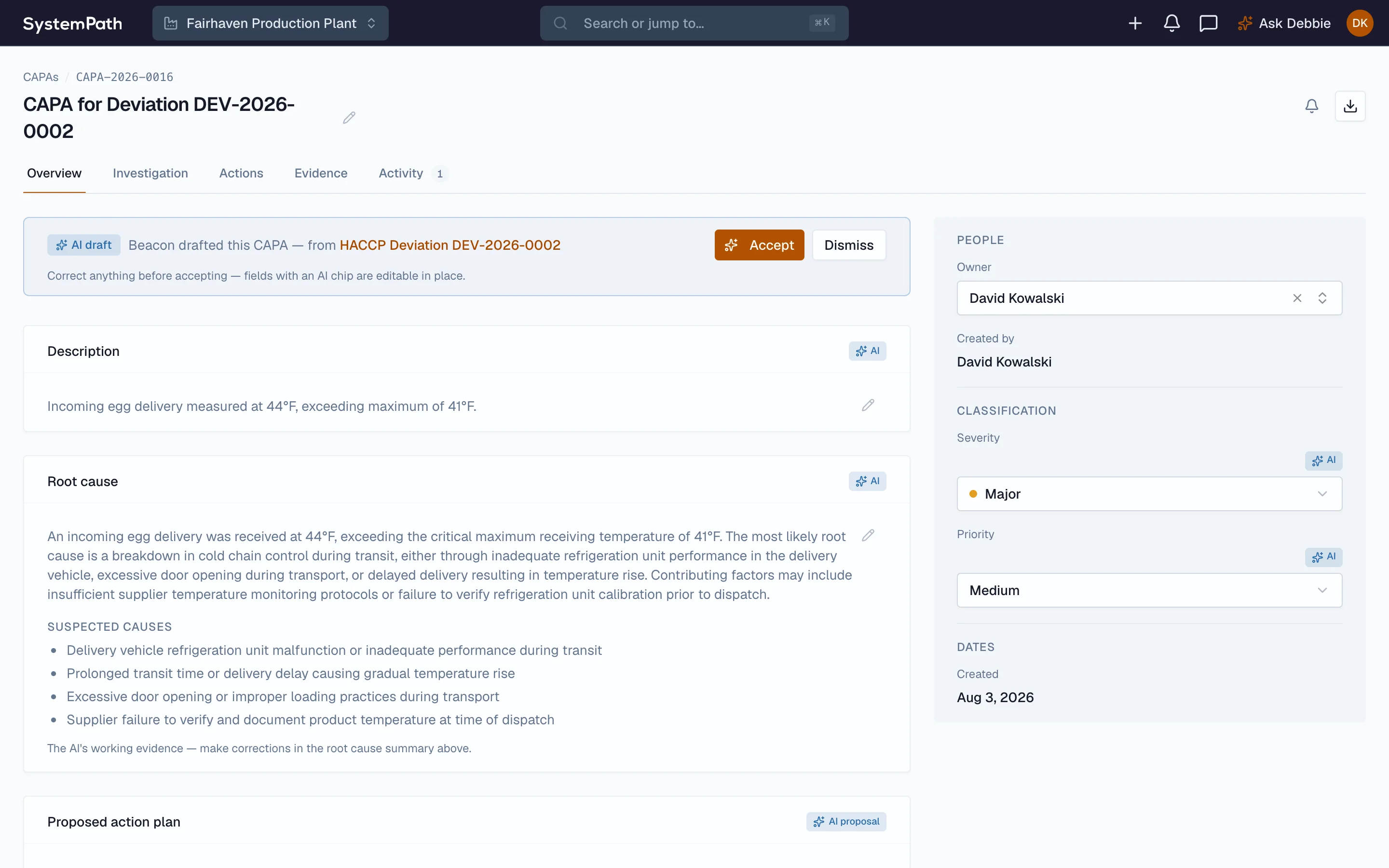
The same pattern repeats wherever the AI works: an action you trigger, a draft you review before it is recorded, and an activity list naming the model that answered and when. This is a complaint record, but the panel is the same one the CAPA, the label, and the audit packet carry.
Explore AI on every surface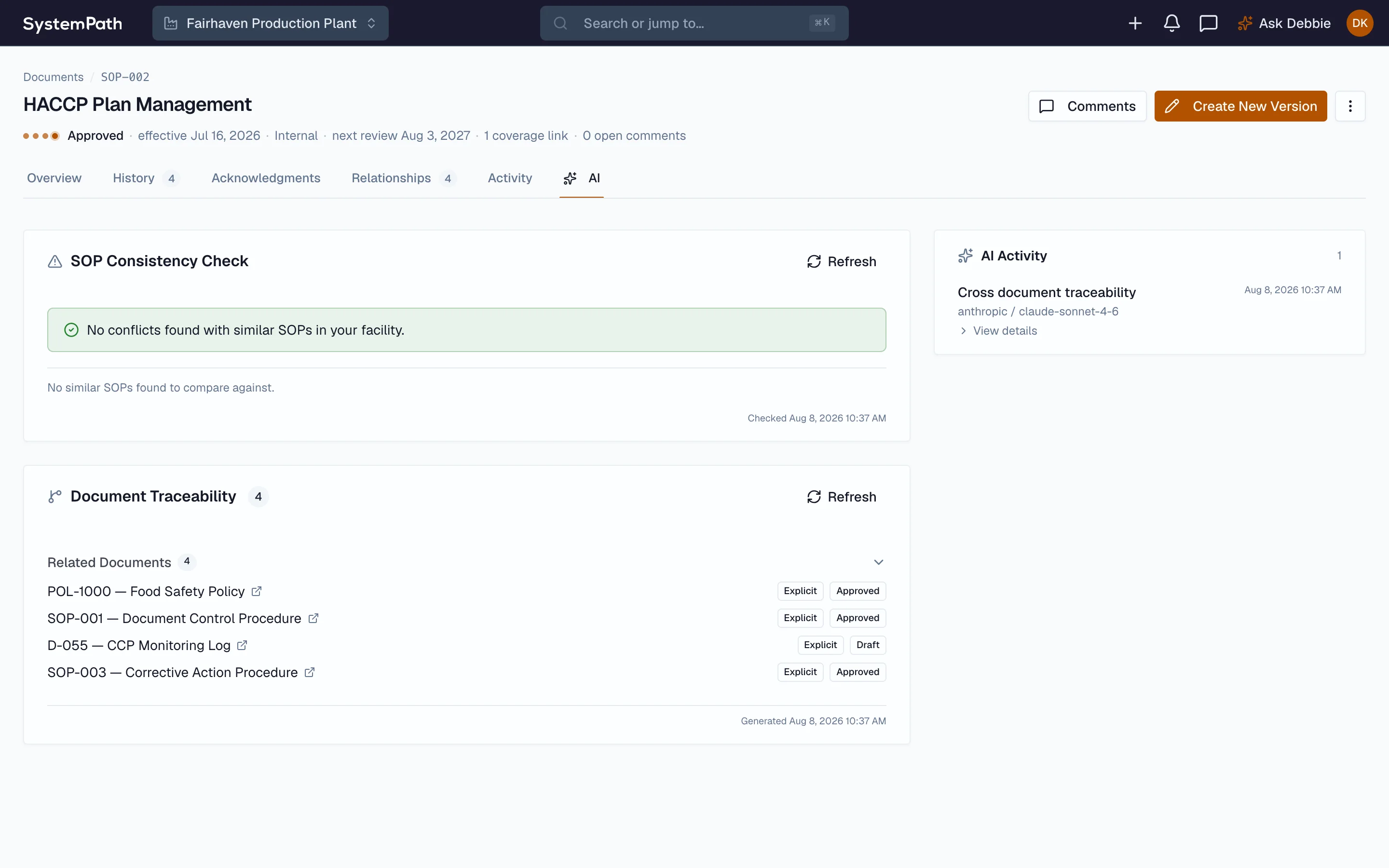
Beacon reads an SOP against the others in your facility and reports conflicts, and maps the documents it genuinely relates to with each link marked explicit or inferred. The AI activity beside it names the model that ran and when, with the evidence a click away.
Explore Consistency checksSee the evidence trail on real work.
A 20-minute walkthrough of an AI-drafted corrective action, the evidence behind it, and the person who decides. Bring the finding you would want it to draft from.
Prefer the phone? (313) 484-4887
What happens next
Discovery call
About where your team loses time, and what you would never automate.
Live walkthrough
An AI draft produced, its evidence opened, and a person disposing of it.
Custom proposal
Software, consulting, and training sized to your operation.
You'll talk with a food safety expert, not a sales rep.
20 minutes · No commitment · No pressure
Questions teams ask about the AI.
Answers from the team that runs Beacon inside a working SQF-certified plant.
Every time Beacon's AI writes something, a drafted CAPA, a classified finding, a parsed document, it leaves an evidence item behind. The item records what the AI was given, which model answered, the sources it drew on, and the moment it happened. A qualified person then accepts or rejects the proposal, and that decision is recorded too. The trail is append-only, so the history of every AI action is intact and one click away on more than thirty places in the app.
No. The AI proposes; a person disposes. It drafts a corrective action, flags a conflict, or reads a document, and a qualified reviewer accepts or rejects the result before it affects your program. Nothing the AI does changes a record unattended, and the reviewer who signed off is captured on the evidence trail. The AI is built to make your experts faster, not to replace their judgment.
You never pick a model. Beacon routes each task to the model that fits it, from fast models for classification and search to stronger models for drafting and reasoning, and the routing is handled for you. That means the platform can adopt better models as they ship without changing how your team works, and without locking you to a single provider.
English, Spanish, French, and Arabic, including right-to-left layout for Arabic, across the platform. A line operator can read a checklist and an AI prompt in their own language while corporate quality reviews the same record in English. The AI works in the language the user is in.
No. Content processed by Beacon's AI is covered by enterprise terms that prohibit training on your data, and the AI providers are named in our privacy policy. Your records stay your records.
The vision pipeline reads certificates of analysis, labels, and equipment photos and pulls the data out for your review, so a supplier COA or a label spec does not have to be retyped by hand. The extracted values are surfaced for a person to confirm before they are used, with the original image kept on the evidence trail.