


Your label, generated from your recipe.
FDA 21 CFR 101 labels built from your recipe and allergen data, with retailer overlays and drift detection that flags a label the moment its recipe changes.
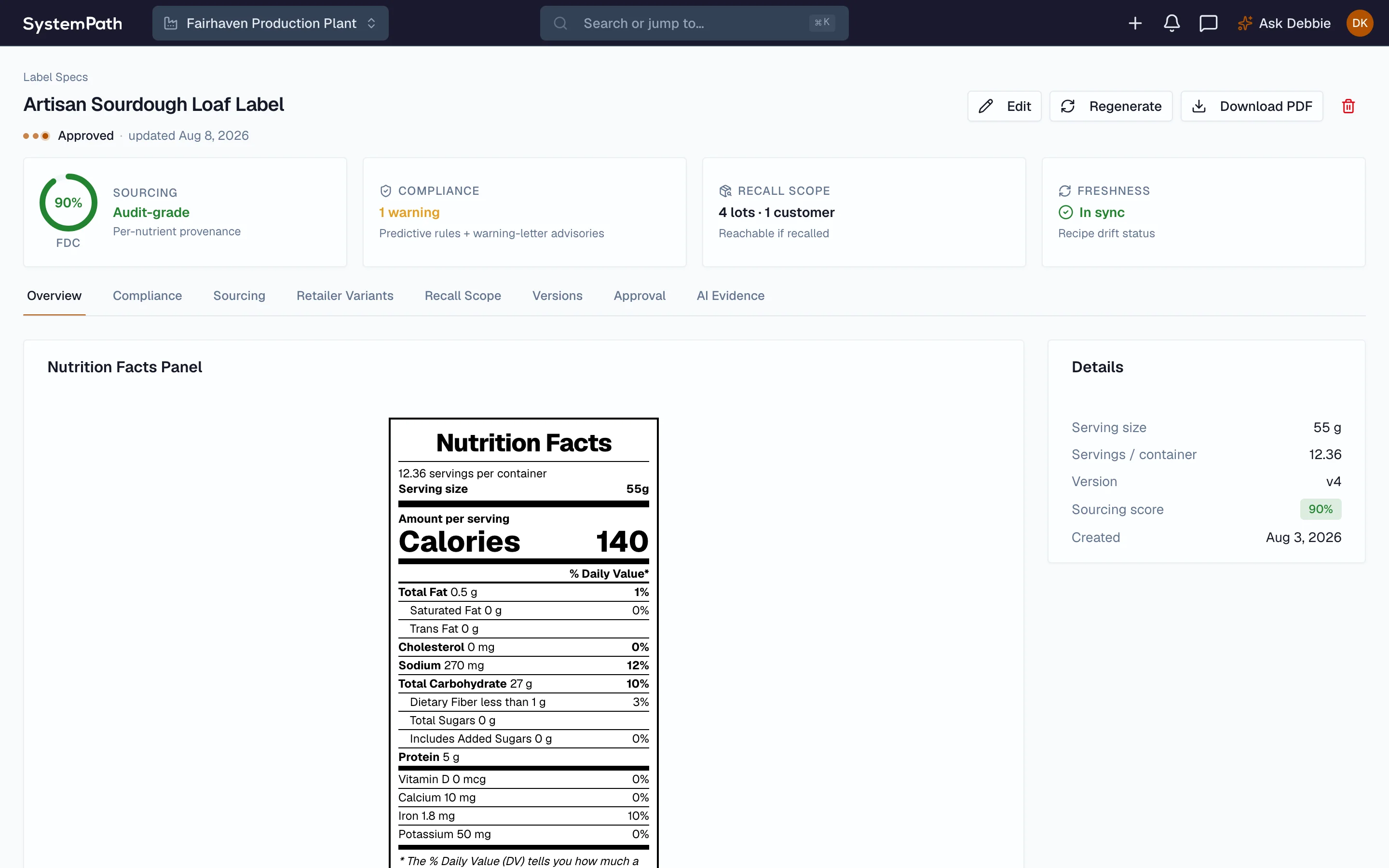
Every required FDA field, assembled from your data.
The statement of identity, the ingredient statement in descending order, the allergen statement, net quantity, the manufacturer block, and country of origin are assembled from the recipe and product data your plant already keeps. You get an artwork canvas and a compliance report side by side, so the label and the reasoning behind it are both in front of you. Bringing an existing catalog in does not mean retyping it: photograph a current label and the vision pipeline extracts the structured fields for you to check.
- The FDA 21 CFR 101 structural fields, field by field
- Ingredient and allergen statements from your recipe
- Four nutrition facts panel variants, formatted to FDA layout
- Dual PDF: artwork canvas plus compliance report
- Photograph an existing label and import the fields
- A GS1 Digital Link payload with a public lot resolver
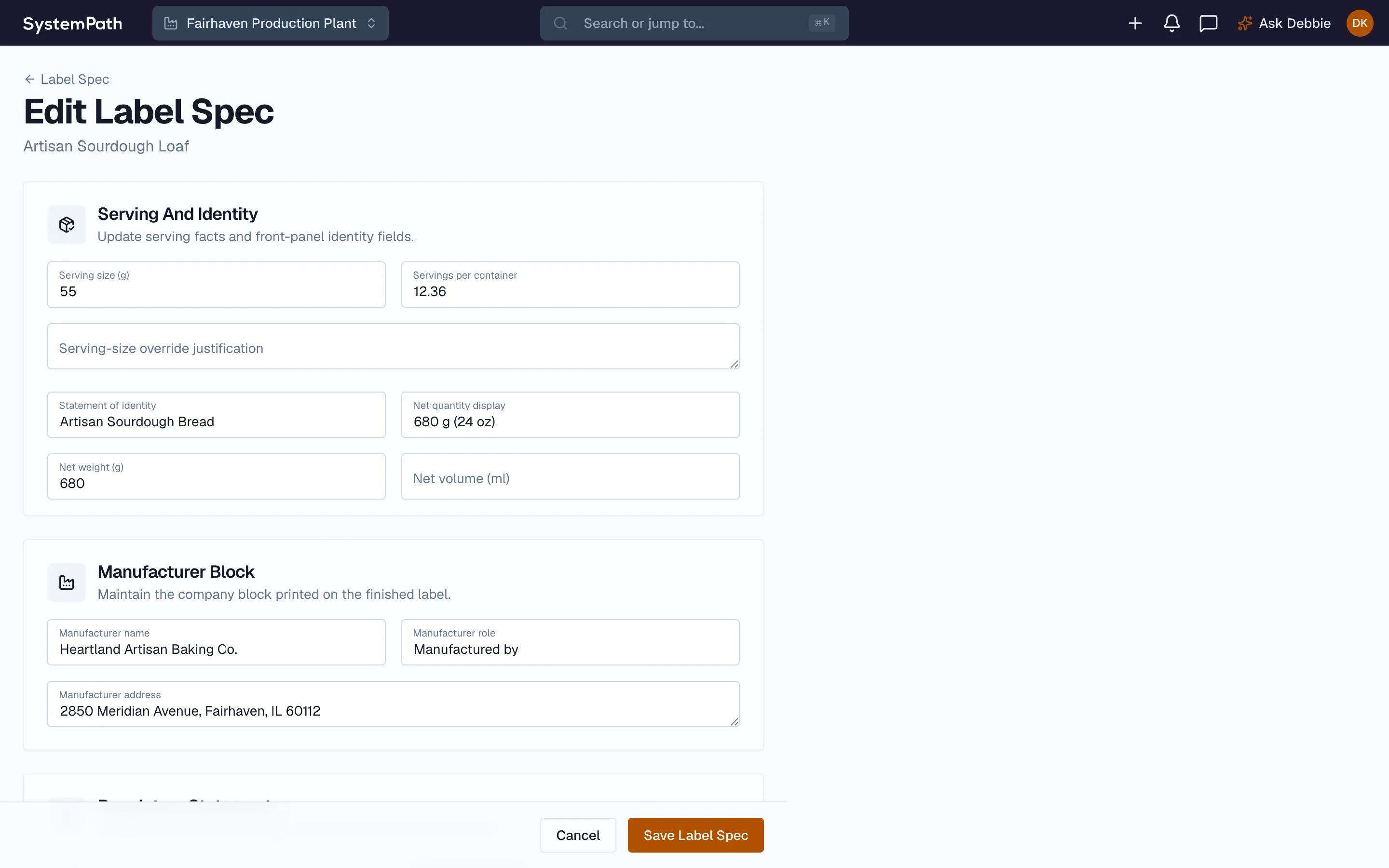
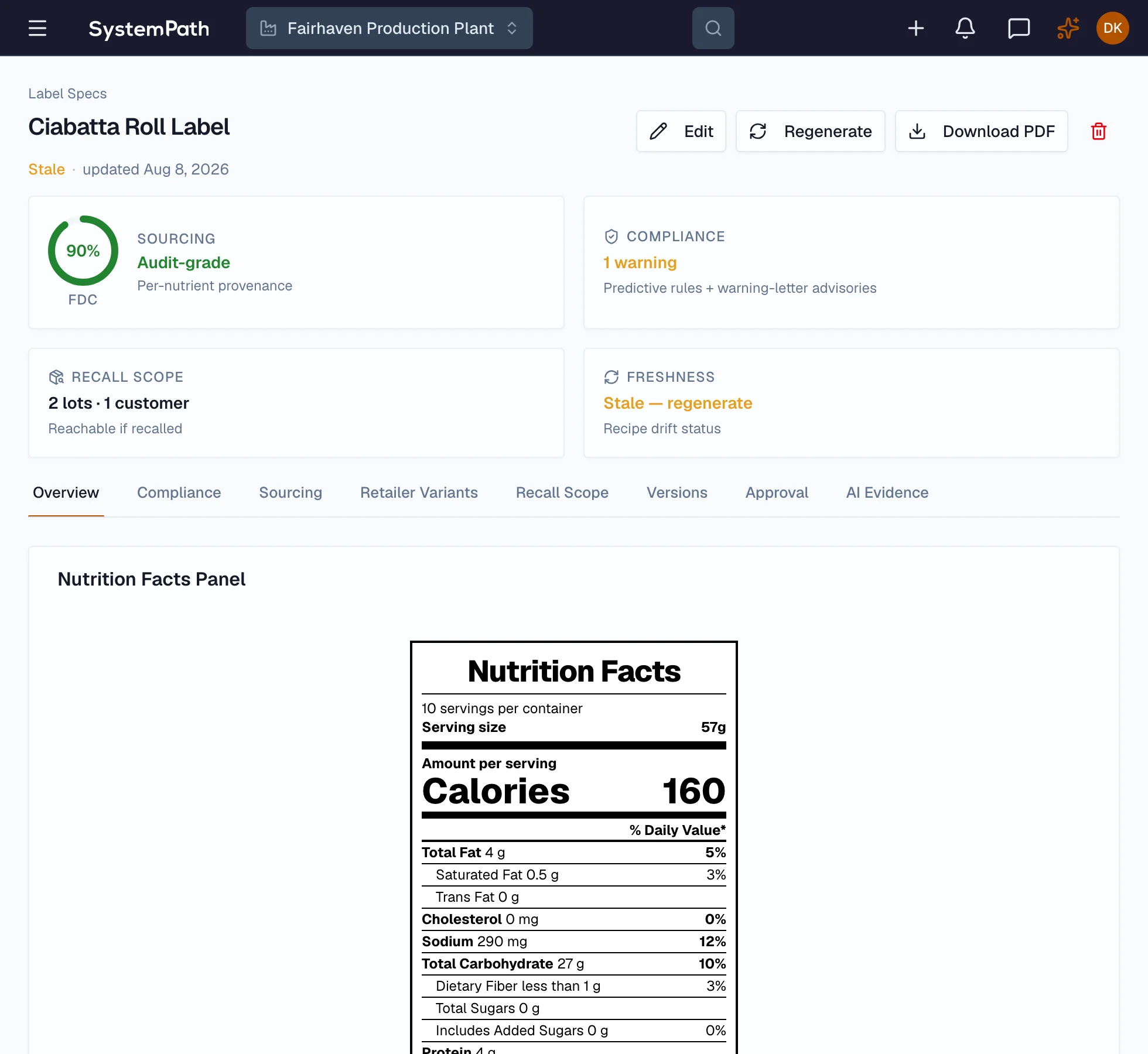
A label that tells you when it is out of date.
This is the part competitors skip. Every label is anchored to a snapshot of the exact inputs it was built from and pinned to a recipe version. A nightly check compares the live source against that snapshot, and a divergence marks the label stale and notifies you. Each generation is its own immutable version, so a label's history is a record. Because labels are scoped by customer, a co-packer runs a separate label per brand and each one is watched on its own.
- Source snapshot of the exact recipe and product data
- Recipe-version pinning per label
- Nightly drift detection that flags stale labels
- Immutable, append-only version history
- A separate label per customer brand, watched separately
- Approval routing before a label is marked approved
Checked against the rules that are not here yet.
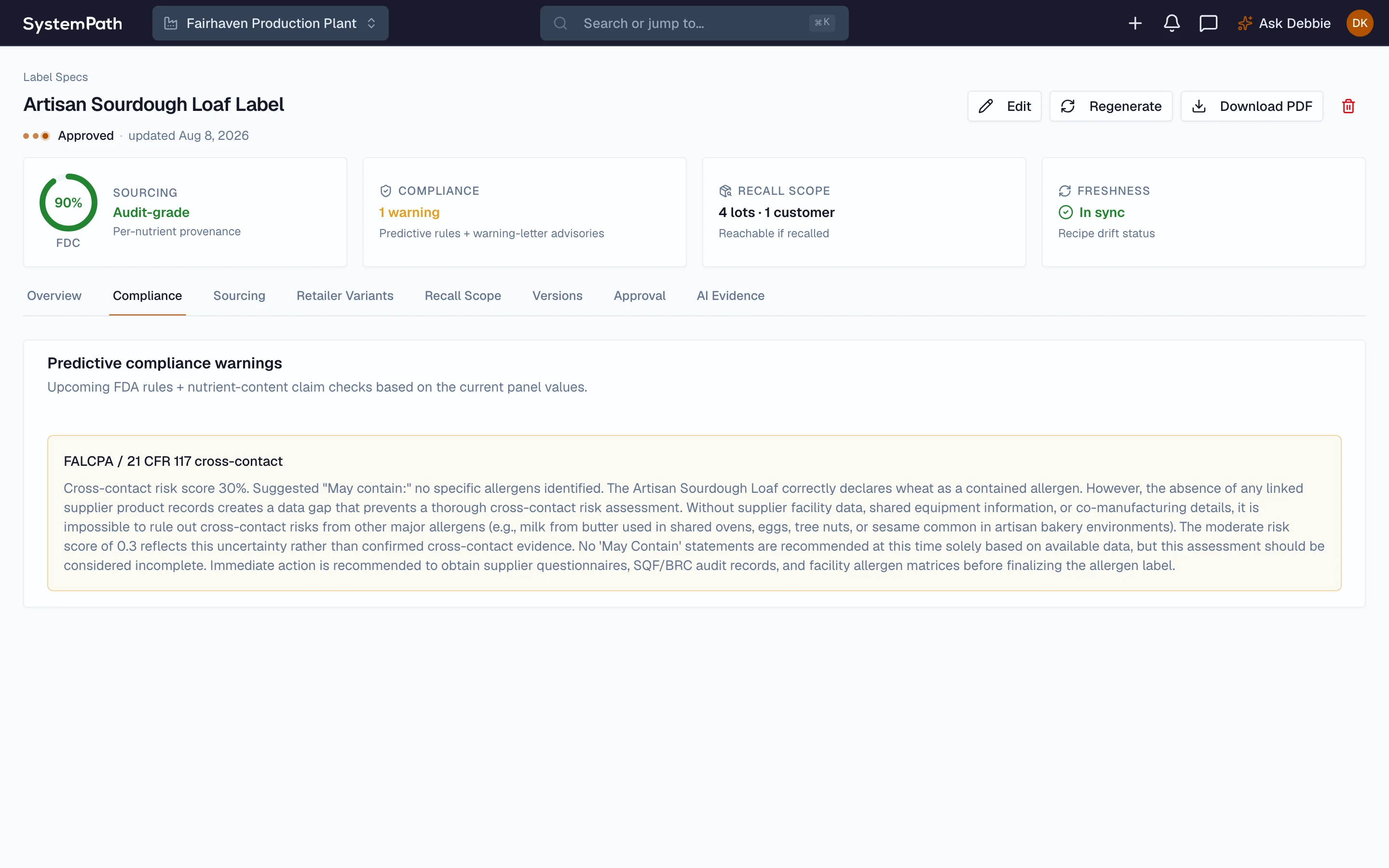
Beacon checks a label against the rules in force today, including bioengineered-food disclosure, and against the ones still coming: the 2028 front-of-pack nutrition label and the updated "Healthy" definition. It also matches your claims against patterns from published FDA warning letters. A warning names the rule it came from and explains what is missing, so it is a finding your team can act on rather than a red dot.
- Bioengineered-food disclosure checked on the current panel
- Front-of-pack 2028 and the new "Healthy" definition
- Claims matched against published FDA warning letters
- Each warning cites the rule and what it would take to clear
What the nutrition panel is, and what it isn't.
The nutrition facts panel is generated from your recipe data and formatted to the FDA layout, as a starting point for your artwork. It is not a substitute for a laboratory nutrient analysis, and you should verify the values before you print a label you will sell against.
What Beacon does well today is the structure, the retailer overlays, and the governance: the snapshot, the version pinning, and the drift detection that keep a label honest as your recipe changes. Deterministic, sourced nutrient calculation is on the roadmap. We would rather tell you that than let you find out at an audit.
Every label question a retailer asks, answered before they ask it.
Labeling gets audited from two directions at once: a regulator asking whether the panel is right, and a customer asking whether it matches the product you shipped them. Both answers come off the same record.
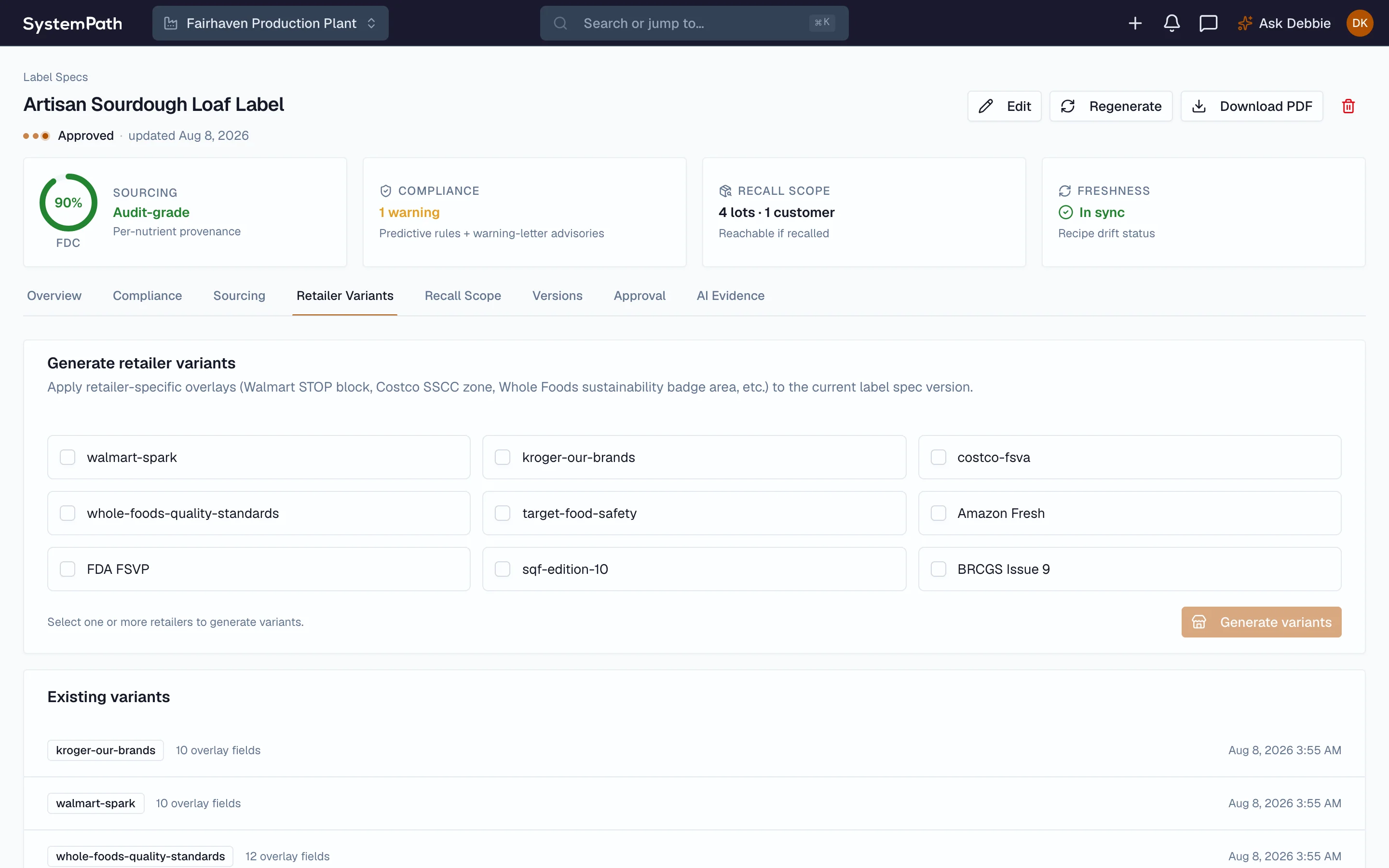
Nine overlays sit on top of the FDA baseline, six retailer rule sets plus FSVP, SQF, and BRCGS. Generate one and the variant records what it changed, so a customer spec is applied rather than hand-rebuilt.
Explore Retailer overlays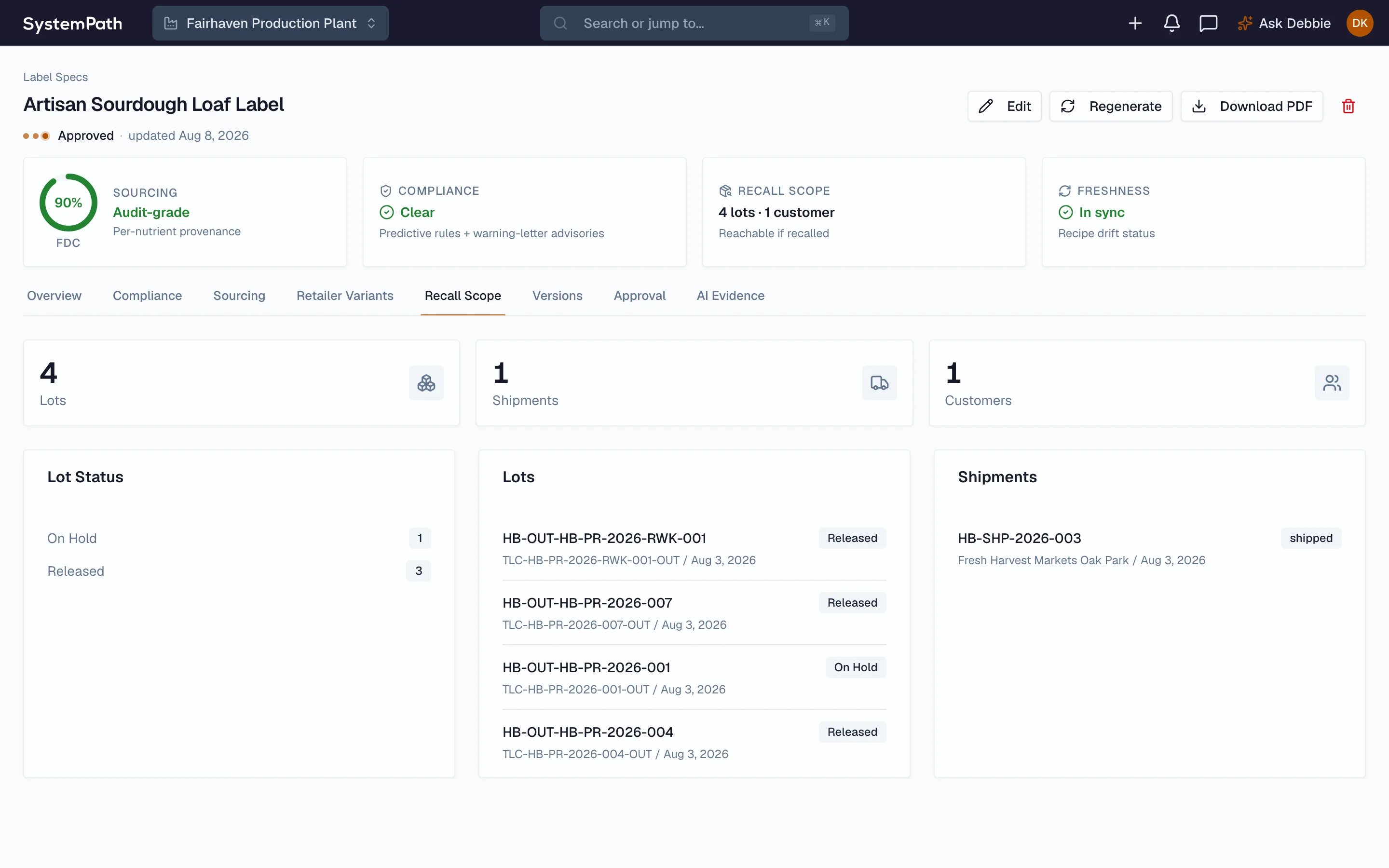
A label knows the lots it was printed against, the shipments those lots left on, and the customers who received them. The blast radius of a labeling error is a screen, not a week of spreadsheet work.
Explore Recall scope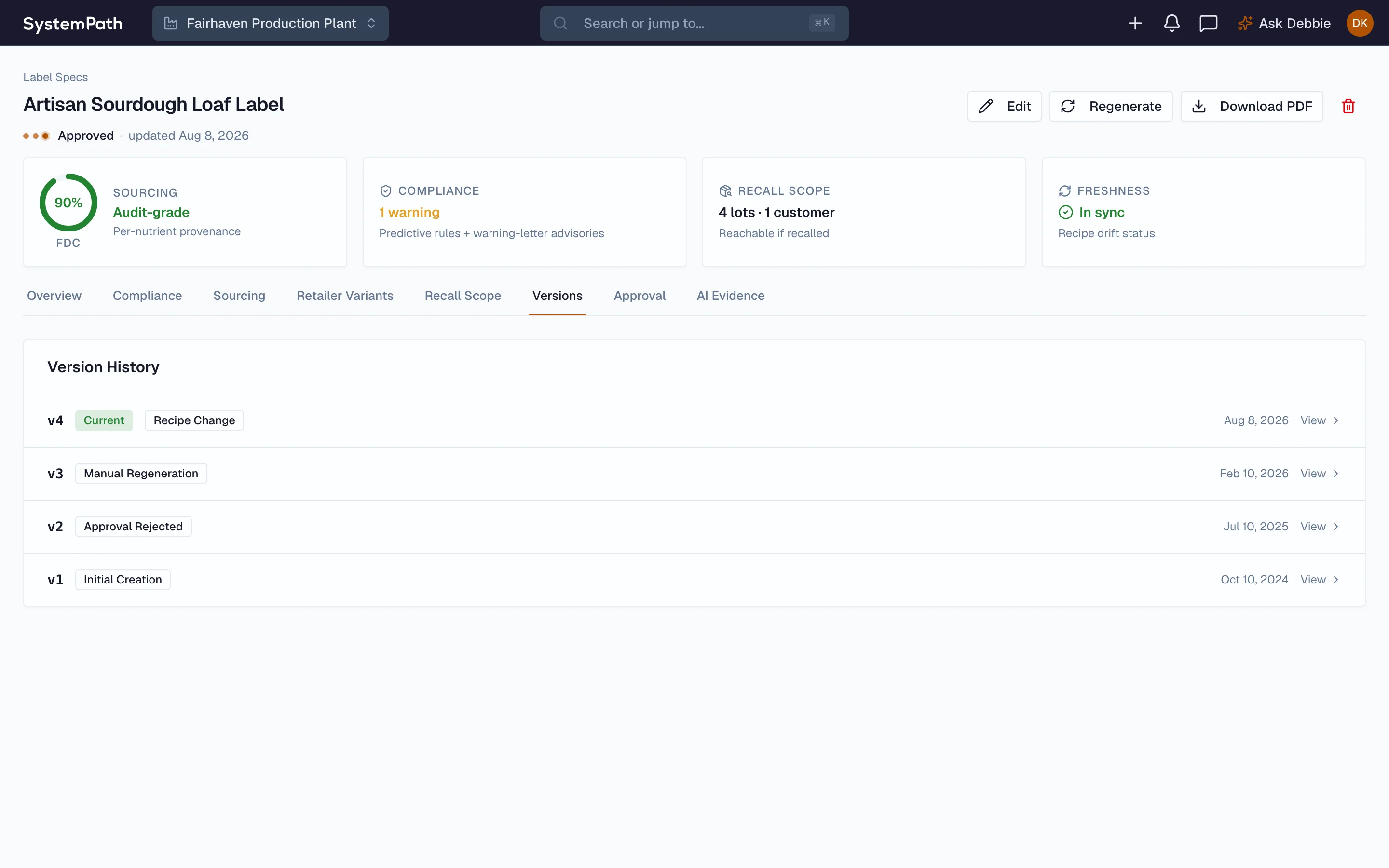
Every generation is its own version, stamped with what triggered it: an initial issue, a rejected approval, a manual regeneration, a recipe change. The history of a label is a record rather than a memory.
Explore Version history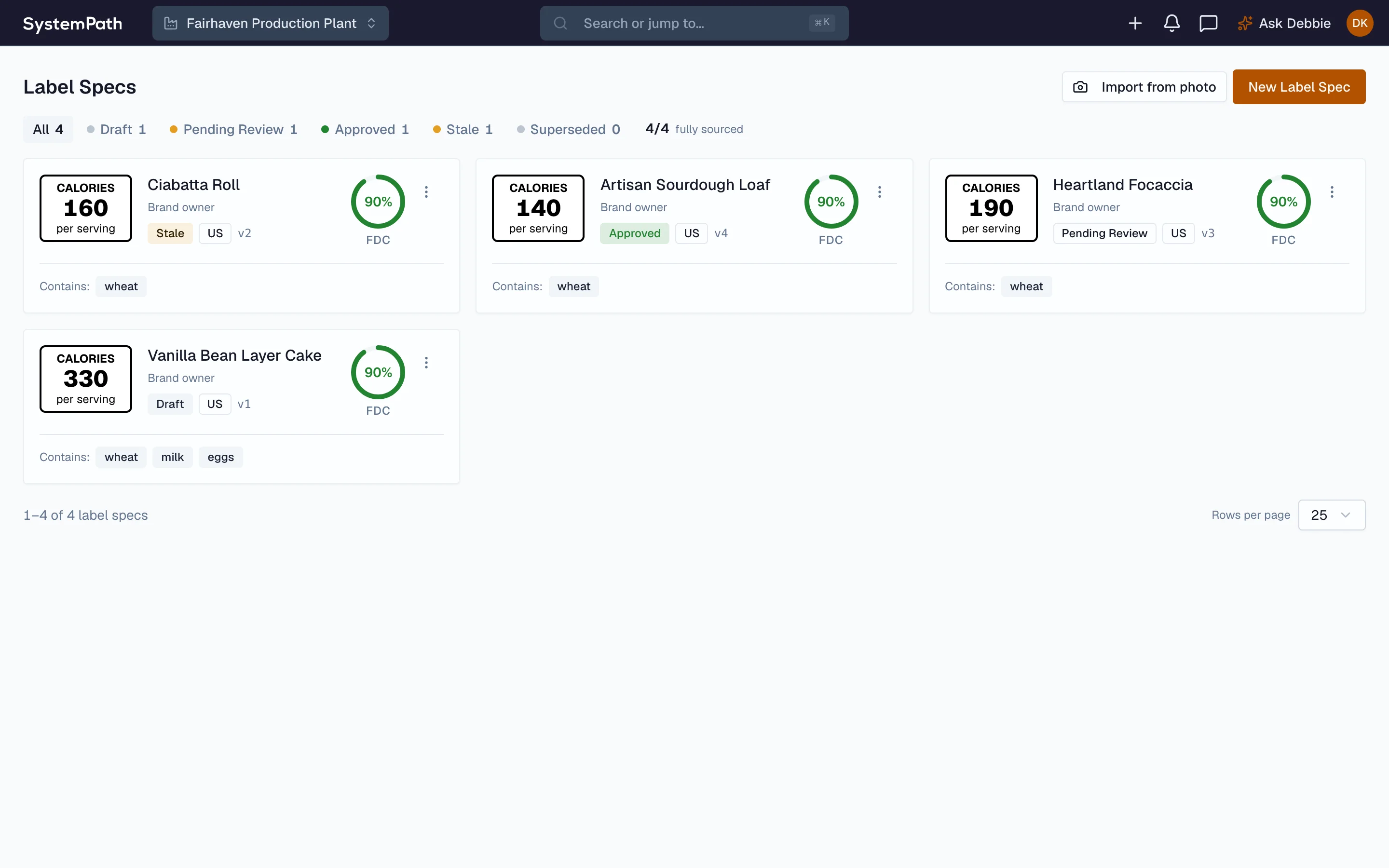
The catalog carries status per label, draft through approved through stale, with the version and the nutrient sourcing score on the card. You can answer the question by looking rather than by asking around.
Explore Label catalogSee a label built from a recipe.
A 20-minute walkthrough on real data: a panel generated from a recipe, a retailer overlay applied to it, and a recipe change caught by drift detection.
Prefer the phone? (313) 484-4887
What happens next
Discovery call
About your products, your retailers, and your labeling workload.
Live walkthrough
A label generated from a recipe, then caught by a recipe change.
Custom proposal
Software, consulting, and training sized to your operation.
You'll talk with a food safety expert, not a sales rep.
20 minutes · No commitment · No pressure
Questions labeling teams ask.
Answers from the team that runs Beacon inside a working SQF-certified plant.
From your recipe, allergen, and product data, Beacon assembles a US FDA 21 CFR 101 label: the statement of identity, ingredient statement, allergen statement, net quantity, manufacturer block, country of origin, a nutrition facts panel, and the barcode payload. It renders two PDFs, the artwork canvas and a compliance report, so you can see the label and the reasoning behind it.
The nutrition facts panel is generated from your recipe data and formatted to the FDA layout, as a starting point for your label artwork. It is not a substitute for a laboratory nutrient analysis, and you should verify values before printing a label you will sell against. What Beacon does today is the structure, the formatting, the retailer overlays, and the governance around the panel. Deterministic, sourced nutrient calculation is on the roadmap.
Every label is anchored to a snapshot of the exact recipe, allergen, and product data it was built from, and pinned to a recipe version. A nightly check compares the live source against that snapshot, and if they have diverged it marks the label stale and notifies you. You find out a label is out of date because the system told you, not because a customer did.
Yes. Nine overlays, six retailer rule sets plus FSVP, SQF, and BRCGS, apply the extra formatting and content rules a program requires on top of the FDA baseline, so a label can be assembled to a customer's spec without rebuilding it by hand. Because labels are scoped by customer, a co-packer can run a different label for each brand it packs.
Yes. Photograph an existing label and Beacon's vision pipeline extracts the structured fields so you can bring a current product into the system without retyping it. It is the fastest way to get an existing catalog onto a managed label record.
Beacon checks labels against the rules in force today, including bioengineered-food disclosure, and the ones still coming, like the 2028 front-of-pack nutrition label and the updated "Healthy" claim definition. It also matches label claims against patterns from published FDA warning letters, so a risky claim gets flagged before it ships, not after.